
Most school reunification plans fail in the same five places: the pickup person nobody planned for,...
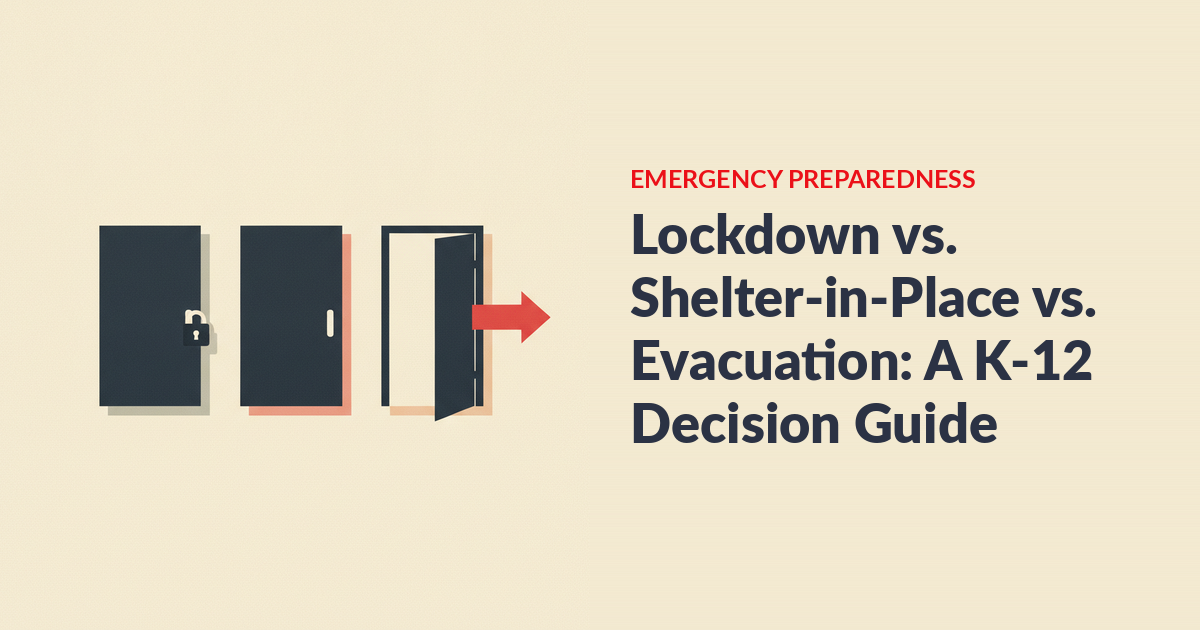
Lockdown vs. Shelter-in-Place vs. Evacuation: A K-12 Decision Guide
The difference between lockdown vs shelter in place vs evacuation comes down to where the danger is. Lockdown answers a threat inside the building: lock the door, lights off, out of sight. Shelter-in-place answers an outside hazard like weather or chemicals: stay indoors and protect. Evacuation answers a dangerous building: get everyone out.
Quick answer
- Lockdown = threat inside → lock, hide, silence.
- Shelter-in-place = hazard outside (tornado, hazmat) → stay in, use the hazard-specific safety strategy.
- Evacuation = the building itself is unsafe (fire, gas) → move everyone to a rally point or off-site location.
What’s the difference between lockdown, shelter-in-place, and evacuation?
Each response matches a different location of danger: inside the building, outside the building, or the building itself. The Standard Response Protocol (SRP) from the I Love U Guys Foundation adds two more conditions — Secure and Hold — that prevent schools from over-responding to smaller events.
| Response | Where’s the danger? | Core action | Example triggers |
|---|---|---|---|
| Lockdown | Inside the building | “Locks, lights, out of sight” — lock the door, hide, stay silent | Intruder, violence inside the school |
| Shelter-in-place | Outside — environmental | Get indoors; use the hazard’s safety strategy (tornado positions, sealing for hazmat) | Tornado, chemical release, severe air quality |
| Evacuation | The building itself | Move everyone out to a rally point or off-site location | Fire, gas leak, structural damage |
| Secure (SRP) | Outside — human threat | Get inside, lock outside doors; teaching continues indoors | Police activity in the neighborhood |
| Hold (SRP) | Hallways only | Stay in your room or area, clear the halls; class continues | Medical emergency in a corridor, a spill |
The distinctions matter because the actions conflict. Evacuating during a lockdown moves people toward a threat. Locking down during a fire traps them. The response name is a set of instructions — which is why everyone has to know all five.
When should a school call a lockdown?
Call a lockdown when a threat is inside the building or close enough that movement is dangerous. Doors lock, lights go off, everyone moves out of sight and stays quiet. Nobody enters or leaves — including parents, which is worth telling families before an event, not during one.
The most common lockdown mistake is using it for everything. Police activity three blocks away doesn’t require students under desks; it requires Secure — outside doors locked, classes running normally inside. Districts that use the full range of responses spare students and staff the fear cost of unnecessary full lockdowns, and keep the real thing meaningful.
When does shelter-in-place apply?
Shelter-in-place applies when the outdoors is the hazard and the building is the protection — most often severe weather or an airborne chemical release. Unlike lockdown, the point is not hiding from a person; it’s putting walls between people and the environment.
The action varies by hazard, and staff need to know which version is in play:
- Tornado: move to interior rooms and lowest floors, away from windows.
- Hazmat: stay inside, shut doors and windows, shut down air handling if that’s your protocol.
- Air quality or wildlife: simply remain indoors and carry on.
That’s why a shelter announcement should always carry the hazard and the strategy — “Shelter: tornado” tells staff what to do; “shelter-in-place” alone leaves them guessing which playbook applies.
When should you evacuate?
Evacuate when the building itself is or may become dangerous — fire, gas leak, structural concern — and being outside or elsewhere is safer than staying. Everyone moves along planned routes to a rally point, staff take accountability, and if the building can’t reopen, the day ends in an off-site reunification with parents.
Evacuation is also the response most likely to be combined with others. An event can start as a lockdown and end as a controlled, police-led evacuation; a shelter-in-place for weather can become an evacuation if the building is damaged. Conditions change, so responses change — which puts a premium on announcements that everyone receives and understands, everywhere on campus.
What is the “which door?” problem?
The “which door?” problem is the gap between knowing what to do and knowing where it’s safe to do it — and it’s the moment generic alerts fail. A teacher’s phone says “EVACUATE.” Her practiced route runs past the gym. If the gas leak is at the gym, the alert just aimed her class at the hazard. East door or west door? The word “evacuate” can’t answer that.
The same gap appears in every response. Lockdown — but the threat is reported in which wing? Shelter — tornado positions or sealed windows? The response name tells staff the action; only location information tells them the direction. This is precisely the gap E3’s Smart Maps close: when the alert goes out, staff see the threat pin and safe exits on a floor-level map, so “evacuate” arrives with a direction instead of a guess.
Until every alert carries that context, train staff to expect a location with every announcement — and train announcers to give one.
How does the Standard Response Protocol keep the language plain?
The SRP standardizes five conditions — Hold, Secure, Lockdown, Evacuate, Shelter — each paired with a plain directive, so a student, a substitute, and a police officer all hear the same words and picture the same actions. The I Love U Guys Foundation publishes it free, and many districts and responder agencies across the country have aligned to it. (The foundation doesn’t endorse vendors — its materials are protocol, not product.)
Plain language matters more than it sounds. Coded announcements — colors, staff-only phrases — fail with substitutes, visitors, and anyone hired after the last training. As one district safety leader put it while overhauling his plans: “I want it all to align… everybody in the same language.” Whatever protocol your district adopts, publish it to families and practice it in your required drills until the words are reflexes.
Who decides which response to call?
Empower the person who sees the danger first — most modern protocols let any staff member initiate a response, because the seconds spent routing a decision through the office are the seconds that matter. The office confirms, adds detail, and escalates or downgrades from there.
That only works with two supports in place. First, training: staff can only call what they can tell apart, which is what drills are for. Second, a way to alert everyone instantly — including the gym, the modulars, and the far field — so one person’s decision becomes everyone’s information at the same moment.
Frequently asked questions
What’s the difference between a lockdown and a secure (lockout)?
Location of the threat. Secure — formerly called lockout — answers a threat outside the building: exterior doors lock, everyone comes inside, and teaching continues normally. Lockdown answers a threat inside: classroom doors lock, lights go off, everyone hides and stays silent. Using Secure for nearby police activity avoids frightening students with a full lockdown that isn’t needed.
Is shelter-in-place the same as a lockdown?
No. Shelter-in-place protects people from an environmental hazard — weather or chemicals — so the focus is positioning and sealing, and class can often continue. Lockdown protects people from a human threat inside the building, so the focus is locked doors, darkness, and silence. Confusing the two leads to the wrong actions at the worst time.
Can a school switch responses in the middle of an event?
Yes, and plans should assume it. A lockdown can end in a police-led evacuation; a weather shelter can become an evacuation if the building is damaged. Every transition creates a risky information gap, so the switch must reach every person at once — including staff outdoors, in modulars, or off-site.
How do students and substitutes know which response is active?
Through plain language, repeated announcements, and practice. Protocols like the SRP pair each condition with its directive — “Lockdown: locks, lights, out of sight” — so the announcement itself is the instruction. Post the actions in every room, include them in substitute folders, and rehearse them in drills so the words trigger actions, not questions.
Do states require schools to drill all of these responses?
Most states mandate school safety drills, but the required types and counts vary — many require lockdown and evacuation (fire) drills, while shelter and secure requirements differ by state. Check your state’s current drill requirements rather than assuming, and treat state minimums as a floor, not a ceiling.
The right word, the right direction, at the same moment
Lockdown, shelter-in-place, evacuate — the definitions are the easy part. The hard part is making sure that when one of those words goes out, every adult on campus hears it, understands it, and knows which way to move.
That’s the minute E3 was built for: one tap alerts every device — silent phones included — and Smart Maps show each staff member the threat location and the safe way out. No guessing, no “which door?” See it on your own floor plans. Book a demo.